Magazine billing and subscription payments software
Magazine billing software turns what you sold into correct invoices and shows what has been paid: advertiser invoices from ad contracts, subscription charges and renewals, credit notes and overdue payments. RunMags does this for magazine and media publishers in the same system as advertising sales and subscriptions, so contract and subscriber data is never typed in twice.
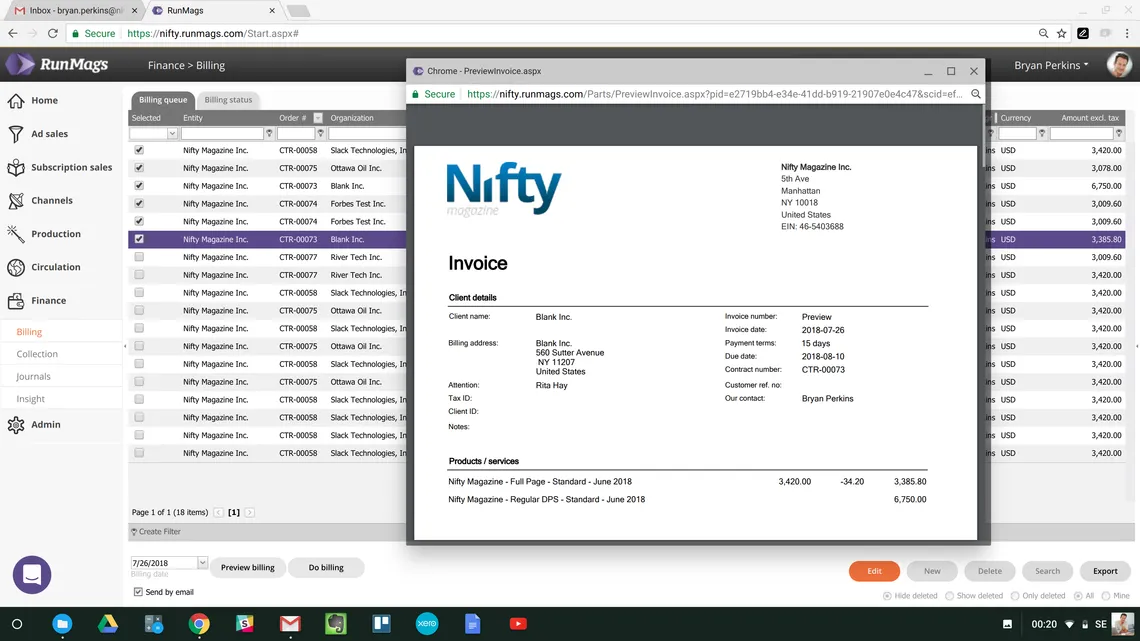
The product information, pricing and terms in your advertising contracts are seamlessly pulled into the invoice so all you have to do is to approve it before it is emailed to your clients.
Review the information behind each publisher invoice
Accurate billing begins before an invoice is created. Check the customer, billing contact, agreed products, prices and relevant legal entity. For advertising, connect the invoice discussion with the signed agreement and the promised delivery. For subscriptions, review the offer and renewal arrangement. The finance team should not have to reconstruct those details from an informal handover.
RunMags supports publishing billing and payment workflows, with Stripe and accounting options including the QuickBooks Online integration, Xero accounting integration and Fortnox accounting integration. Confirm the setup and scope for your chosen services. During a trial, review a representative sale, the billing handover and an exception such as a changed order or a payment that needs reconciliation. See accounting connections and Stripe payments for the next discussion.
Subscription billing for media and magazine publishers
Subscription billing for media publishers means invoicing readers next to the advertisers you already bill, and readers often take the print and digital editions of the same title. In RunMags, subscription invoices and advertiser invoices are handled in one system, alongside advertising sales and circulation.
A reader’s print and digital subscriptions, on issue-based or time-based terms, sit on one subscriber record with their invoices and payments. Readers who subscribe on your branded subscription page pay by card through your connected Stripe account. For orders your service team enters, the rep can choose payment by invoice.
When your team runs the auto-renewal batch, subscriptions set to auto-renew are charged to the subscriber’s saved card, and each renewal order gets its invoice. Subscription payments are listed under Circulation > Subscriptions > Subscription payments. Subscription invoices are not synced to Fortnox, QuickBooks or Xero yet; that sync is on the roadmap.
See how subscriptions are sold and renewed in RunMags magazine subscription management, or read the guide to subscription management for publishers for the whole workflow, from subscriber records to churn.
Media billing software invoices what a media company sells: advertising booked per issue or date, and the subscriptions its readers pay for. Advertising billing software is the advertiser half of that job. In RunMags both run in one system, on the same customer records as your advertising sales and circulation, so each customer’s ad invoices and subscription invoices are in one place.
The media billing process in RunMags runs from booked ad to paid invoice. Sales reps book each ad as a contract row in the RunMags media sales CRM, and the row references the issue or date it runs in. Billing invoices the booked issues up to the billing date you choose, at the price, discount and terms on the contract, and each invoice row keeps its issue reference. A correction is a credit note against the original invoice. Customers, advertiser invoices and their credit notes sync to Fortnox, QuickBooks or Xero per legal entity. Each payment is recorded against its invoice, and finance follows up overdue invoices with reminder letters from Finance > Collection.
Subscription invoices follow the orders and renewal batch described in subscription billing for media publishers. They stay in RunMags and are not part of the accounting sync.
A FEW HELPFUL ANSWERSQuestions about magazine billing and payments
What publishers ask before moving invoicing and payments.
Talk it through with us → What is subscription billing for media publishers?
It is invoicing readers for their subscriptions and collecting their payments, next to the invoices a media or magazine publisher sends its advertisers. In RunMags both run in one system, and a reader's print and digital subscriptions sit on one subscriber record.
Read the guide to subscription management for publishersWhat is media billing?
Media billing is invoicing what a media company sells, advertising booked per issue or date and reader subscriptions, and keeping track of which invoices are paid. Media billing software such as RunMags does this in the same system as advertising sales and circulation. Advertiser invoices sync to Fortnox, QuickBooks or Xero; subscription invoices stay in RunMags.
What does advertising billing software do?
It turns booked ads into invoices without retyping them. In RunMags, billing invoices the booked issues up to the billing date you choose, at the price, discount and terms on the contract, and each invoice row keeps its issue reference. Corrections are credit notes, payments are recorded against each invoice, and finance sends reminder letters for overdue invoices from Finance > Collection.
Does RunMags charge subscription renewals automatically?
No. Renewals are charged when your team runs the renewal batch. At that point, auto-renewing subscriptions are charged to the subscriber's saved card, and each renewal order gets its invoice. There is no scheduled charge in the background.
Read about subscription renewalsWhere do I see subscription payments?
Which invoices sync to my accounting system?
Customers, advertiser invoices and their credit notes sync to Fortnox, QuickBooks or Xero per legal entity. Subscription invoices are not part of that sync; they stay in RunMags.
Compare RunMags plansHow do subscribers and advertisers pay?
Subscribers who order online pay by card through your own connected Stripe account, and service reps can choose payment by invoice for orders they enter. Advertisers pay the invoice you send them, and finance registers each payment against its invoice under Finance > Collection.
See circulation managementHow do I follow up overdue invoices?
Finance sees overdue invoices per organisation under Finance > Collection and sends reminder letters from there. Your team decides when to send them. Finance and sales reps can log activities on the customer so everyone knows what was agreed.
Try the advertising invoice template