
RunMags journal
Nifty production checkpoint: 36 pages, checked print output and a private reader
A magazine workflow needs more than a finished-looking cover. It needs readable stories, an inspectable print file and a clear decision about who may see the issue. Our 1 November Nifty private demo reached a specific checkpoint: a 36-page print master, a verified private reader and preserved editorial copy. Here is what that evidence supports, and what it does not.
A production checkpoint, not a public launch
Nifty's Latest in AI issue is a private demonstration of magazine production and reading. The selected print master contains 36 pages. The reader was checked in a staff-access environment, while an anonymous request for the private issue returned a not-found response. That distinction matters: a functioning private demonstration is not a publicly released magazine, and this update does not announce one.
The useful question is not whether software can produce a file. It is whether the selected output preserves the editorial work, passes the checks actually performed and remains inside the intended access boundary. For this checkpoint, print output, article conservation and reader interactions each have their own evidence. None substitutes for the others.
What the print checks actually established
The selected master is a native PDF/X-4 file. The executed repository preflight checker reported zero errors and one warning concerning ligatures. Its checks covered embedded fonts, an embedded CMYK output profile, trim and bleed boxes, permitted colour spaces and images at a minimum of 300 pixels per inch at their placed size. The preset specifies nine points of bleed and single-page output.
Those are concrete technical checks, not a universal print guarantee. The result is not independent certified PDF/X validation, and no printer-specific stock, binding or spine order was supplied or approved. A production team should still resolve the warning in context and confirm its printer's requirements before treating any file as an approved manufacturing order. Zero reported errors describes this checker and this file, not every possible downstream condition.
Preserving the story matters as much as fitting the page
The final copy-conservation evidence records that all 18 textual editorial articles retain every canonical paragraph in the selected output. This is a narrower and more useful statement than saying a layout is complete because an overset indicator is clear. A story can appear to fit while a continuation is absent from the chosen export. Checking the actual selected file against the intended copy is therefore part of editorial quality control.
Visual polish remains a separate judgement. The issue's recorded review described it as acceptable and template-like, with further art direction still needed. We are not presenting this checkpoint as a premium-design benchmark. Its value is the traceable connection between the editorial source, the exported pages and the checks retained for review.
The private reader was checked beyond its opening screen
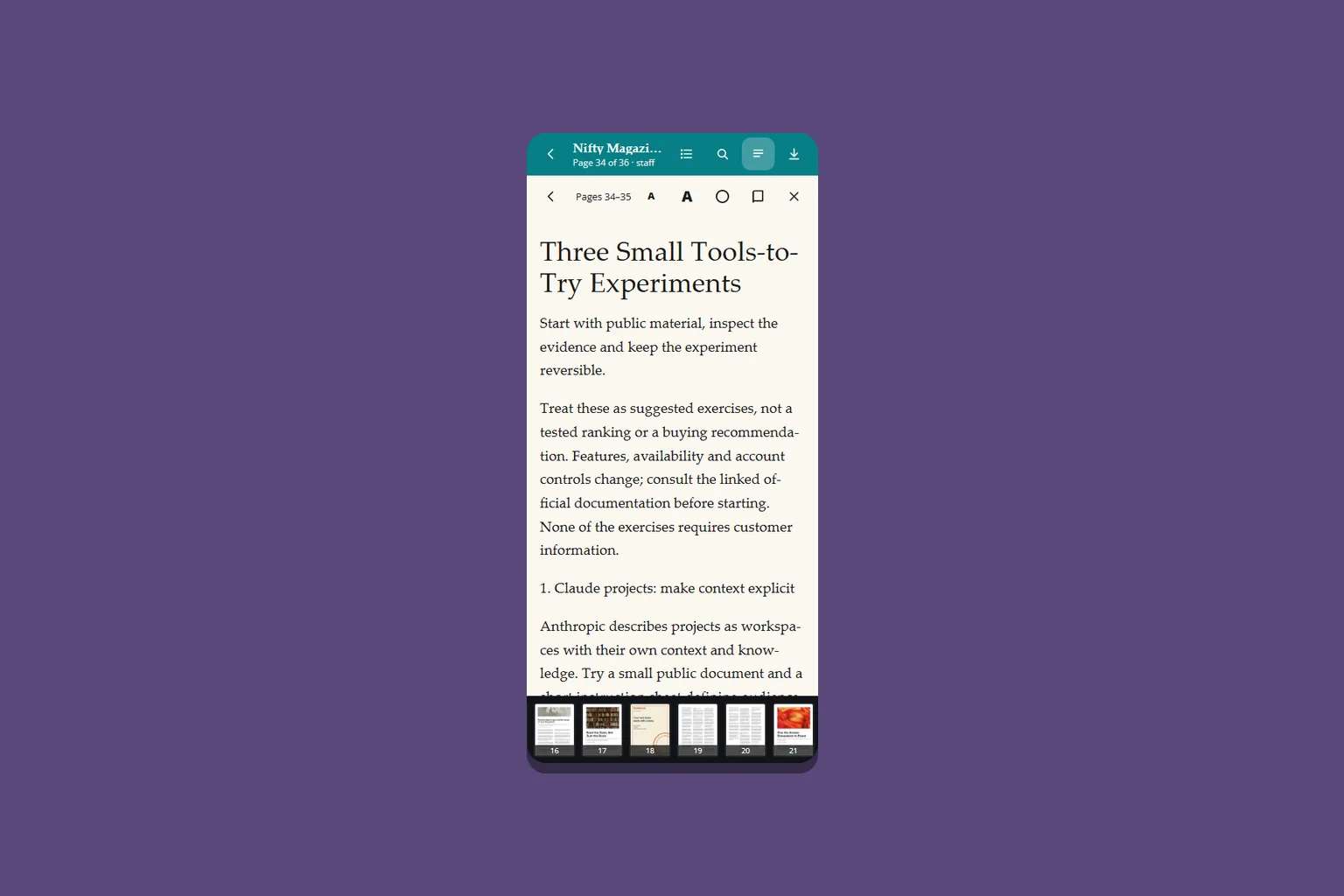
The reader verification included opening the restored feature on page 33 within the 32–33 spread, viewing it at 140 percent zoom and using keyboard paging to reach pages 34–35. A separate mobile check showed the actual sourced article body at a 390-pixel viewport width without horizontal overflow. These observations support a practical reading checkpoint rather than merely showing that a cover or library screen loaded.
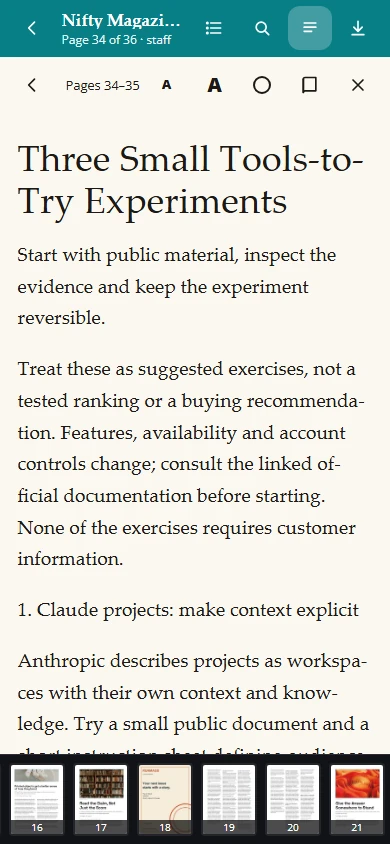
The screenshot above shows text reading in the Nifty private demo. It is an illustration of that bounded workflow, not an invitation to an open newsstand. Private access addresses and staff-session details are deliberately not published here. A reader preview and a public distribution decision remain different things.
Where automation still stops
This issue does not prove autonomous whole-issue generation by Maggie. Native whole-issue artwork attachment and Maggie's draft-card behaviour still have gaps. Cover and own-brand advertising artwork used in export are not evidence that all native Studio attachments are complete. Some editorial preparation was manually sourced and authored through the interface; it would be misleading to describe every news page as autonomously generated.
Scheduled source-worker operation is also not established by this checkpoint. A configured source list is not the same thing as a verified daily sourcing workflow. Public release, production rollout and printer approval retain their own human decisions. Keeping those boundaries visible makes the demonstrated progress more useful: teams can inspect what works without mistaking an unfinished chain for an unattended publishing system.
Use this as a checklist for your own evaluation
When evaluating a magazine workflow, ask to see the selected print file, the exact preflight result, a copy-preservation check and real reader interactions on a narrow screen. Ask separately what still requires an editor, production specialist or release owner. The next conversation should start with your issue structure and approval process, not a promise that one successful export removes every production gate.
Related reading: plan your magazine flatplan, see how a CRM for magazines keeps sales, production and finance on one record, or compare magazine-management workflows.
Frequently asked questions
Is the Nifty magazine publicly available?
No. This checkpoint concerns a verified private staff reader and a private demo print master, not a public magazine release.
Does zero preflight errors mean the file is printer-certified?
No. The repository checker reported zero errors and one ligature warning. Independent certification and approval for a specific printer order were not established.
Was the entire issue produced autonomously?
No. Whole-issue artwork, draft-card and scheduled source-worker gaps remain, and manually prepared editorial work was part of the issue.
Discuss your magazine production workflow with RunMags, including the editorial, print-review and release decisions your team needs to retain. Start a no-card trial or read more RunMags production updates.