
CRM for magazines: one record from first conversation to paid invoice
A CRM for magazines keeps every advertiser, agency and subscriber on one record, linked to their contracts, the issue flatplan and invoices, so sales, production and finance work from the same facts. RunMags is magazine CRM software for small and mid-size publishers, with Maggie, a built-in assistant that suggests the next step while you decide.
14-day free trial · No credit card required · From €399/month excl. VAT
“There is no way a single person could operate a business of my size without it!” Scarlett Redenius, Publisher, Florida Country Magazine: read the case study
Updated .
Your CRM for magazines should follow the whole job.
When a sales conversation becomes an ad booking, production and finance need the same context.
Advertisers & ad sales
Organizations, contacts, activities and advertising deals together, in an ad sales CRM for media sales teams. See managing advertisers and contacts.
Explore advertising salesSubscribers & subscriptions
Subscriber records and subscriptions alongside the rest of your publishing business, with import assistance for existing subscribers.
Explore subscription salesProposals & contracts
Agreed advertising becomes a proposal and a contract with electronic signature, connected to production planning.
See contract managementBilling & payments
Invoices and payments stay connected to the customer relationship, so you can see what has been billed and what needs attention.
Explore billing and paymentsThe CRM for magazines in the product: contract and flatplan.
A signed booking on the advertiser record becomes an ad waiting to be placed on an issue page. These screens show both ends of that chain.
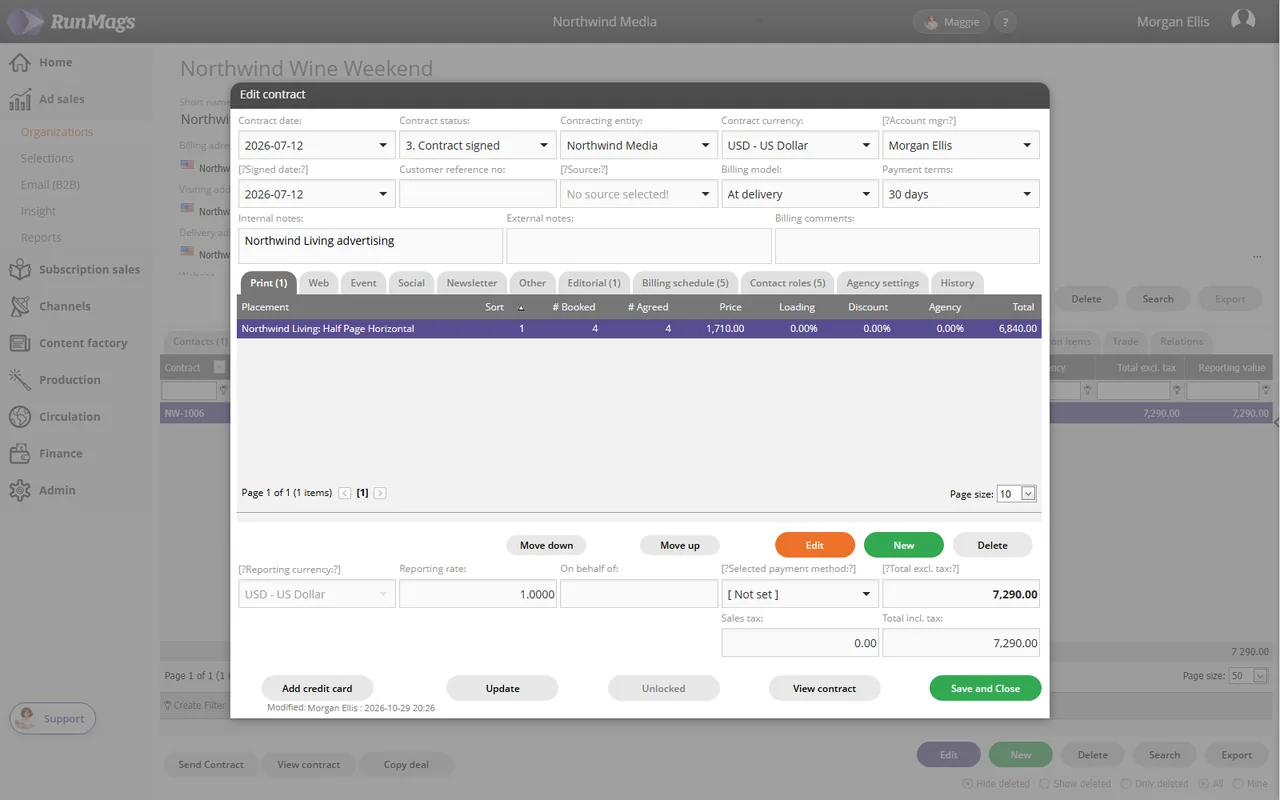
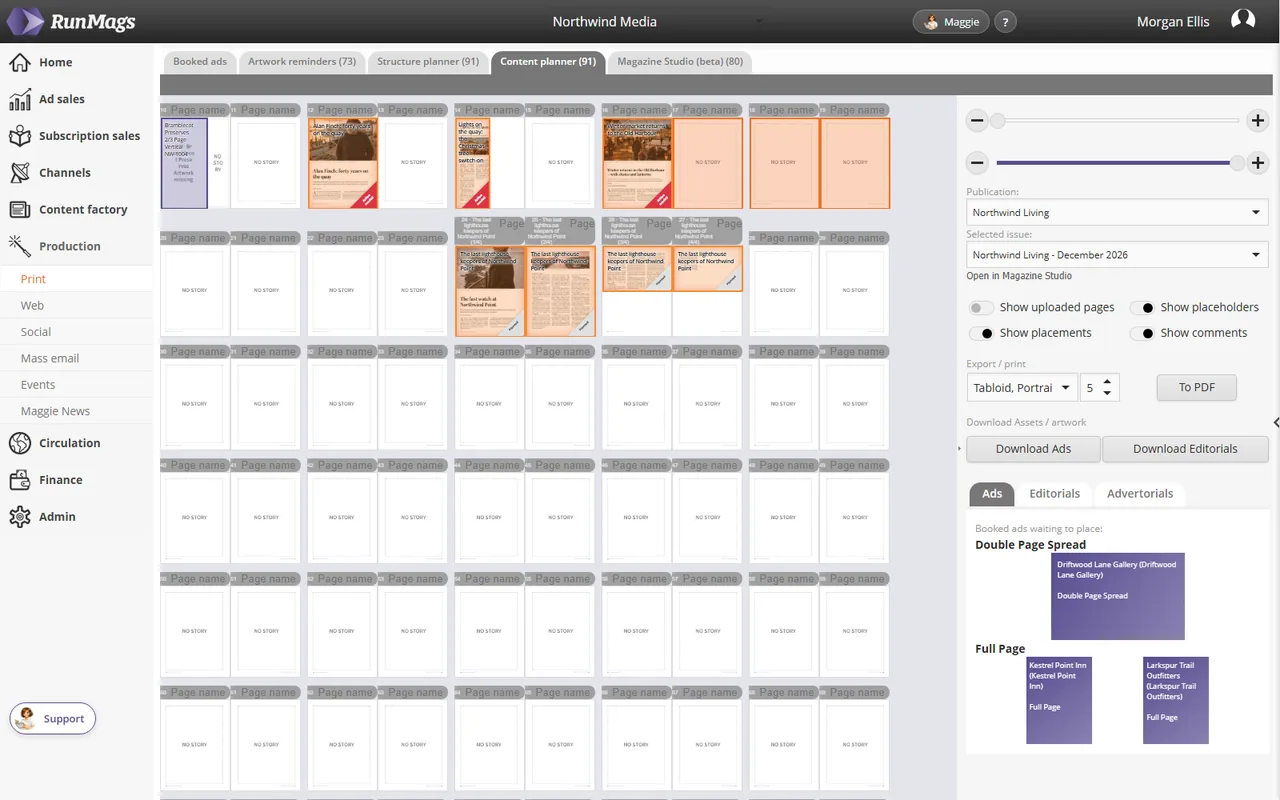
Screenshots from the RunMags demo environment, October 2026. The publisher, advertisers and people are fictional, and your account can look different as releases roll out.
Explore flatplanning and production · See contract management and fulfillment
CRM for magazines, built for the way magazines sell
Ask any CRM you evaluate to show each of these with your own data.
One advertiser across titles
A brand that buys space in two of your magazines is one advertiser, not two. A cross-title deal is one contract with a row for each title and issue, and invoices follow the legal entity on the contract.
See multi-title publishing in RunMagsAgency relations
Many advertisers book through an agency. An agency relation on the advertiser puts the agency’s contacts on its contracts, and agency commission is handled on the contract.
See the ad sales CRM for agencies and advertisersA subscriber who also advertises
A company that books advertising may also buy subscriptions for its staff. Linked to one organization, both stay on one record that sales and renewals staff share.
Read how subscriptions share the recordSubscribers and advertisers on one customer record
In RunMags, magazine CRM software and subscription management work on the same customers: a subscriber can be linked to a contact or organization, so one organization keeps its advertising orders and its subscriptions on one record instead of in two systems that drift apart.
Subscriptions can be print or digital, on issue-based or time-based terms, and RunMags builds each issue’s distribution list from active subscriptions. Your team runs the renewal batch, and auto-renewing subscriptions are charged to the subscriber’s saved card at that point; RunMags does not yet schedule automatic renewals or retry failed card payments. Subscriber self-service for card updates, invoices and cancellation is on the roadmap.
Maggie checks ahead.
You decide.
When you log in, Maggie checks what needs attention: renewals due, unpaid invoices or missing ad material. She suggests the next step and helps you work through sales, contracts, billing and production. You decide what to do.
Bring your real workflow to the demo: how an advertiser moves from proposal to signed contract, how sales commitments reach production, and where you review subscriptions and unpaid invoices.
Book your workflow walkthrough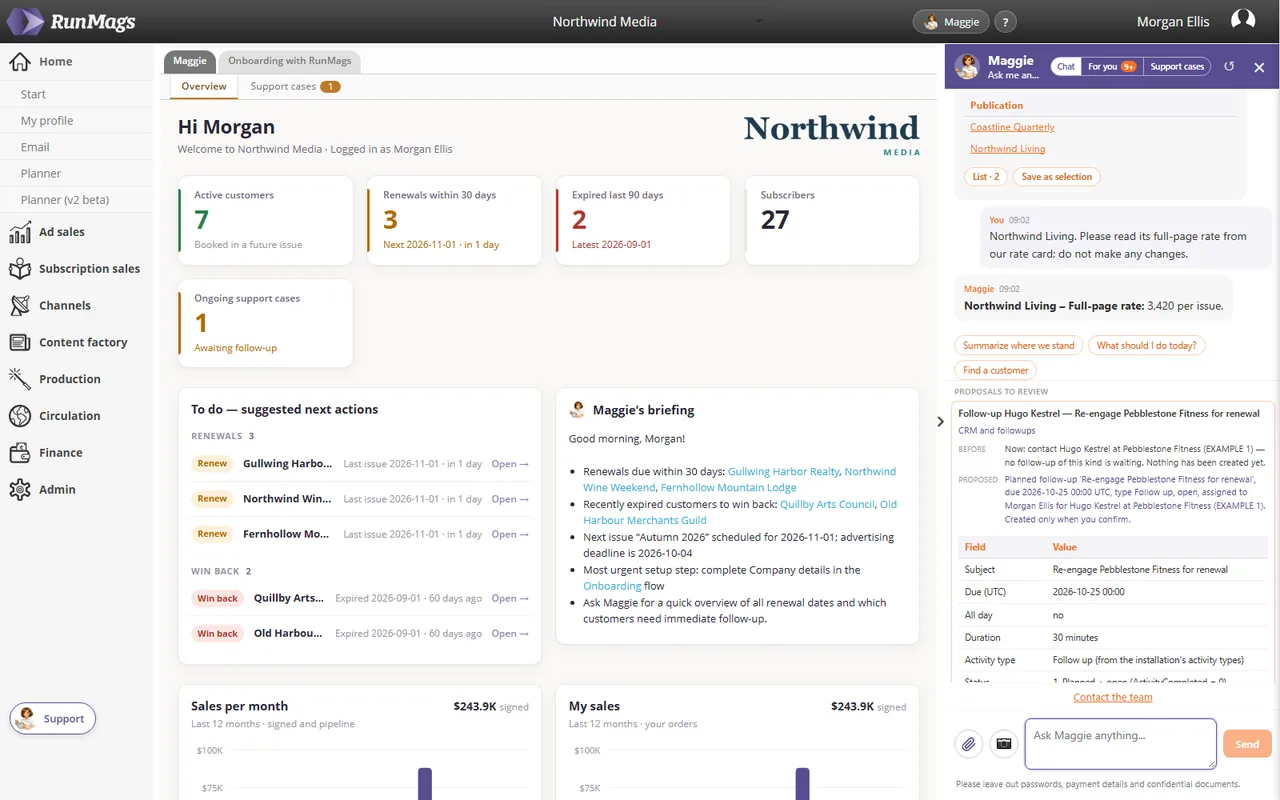
Magazine CRM comparison: RunMags, Magazine Manager, Ad Orbit and Lineup Adpoint
These are the publishing CRM and ad-sales platforms buyers most often shortlist next to RunMags. Competitor cells come from each vendor’s own public pages, read on . They are vendor claims we did not test; where a page is silent we say so rather than say the vendor lacks the feature.
| What to check | RunMags | Magazine Manager (Mirabel) | Ad Orbit (MagHub) | Lineup Adpoint |
|---|---|---|---|---|
| Published price | From €399/month excl. VAT; plans sized by legal entities and brands | $92 down to $66 per user per month by team size (3–5 users to 51+), billed annually | Standard from $76 per user per month, 5-user minimum; other editions on request | No public price; book a demo |
| Advertiser and agency CRM | Organizations, contacts, agencies and activities, with bookings and invoices on the record. No opportunity pipeline with win probability, no email or calendar sync | Publishing CRM; proposals from rate cards convert to insertion orders; calls, emails and meetings logged | Advertising CRM with opportunity management and sales pipeline | Adpoint CRM for media sales; an assistant connects Outlook and Gmail |
| Subscriptions on the same system | Subscribers linked to the same contact or organization; print and digital; staff run the renewal batch | Subscription management built in | Lists subscription and distribution | Not mentioned on the Adpoint pages read |
| Issue planning | Flatplan: signed print ads wait to be placed on pages | Insertion orders route to the flat plan | Ad ops and production workflows; flatplan not named on the pages read | Order management; flatplan not named on the pages read |
| Inventory availability checks | None today: no inventory holds or double-booking guard | Real-time inventory tracking | Real-time inventory tracking for print, digital and events | Real-time availability checking in order management |
| Accounting and ad-server links | QuickBooks, Xero and Fortnox per legal entity; no Google Ad Manager | 21 connected apps, including QuickBooks, Xero, Sage, Epicor, Microsoft Dynamics Great Plains and a two-way Google Ad Manager sync | GL/ERP sync and APIs included | Multi-office, multi-currency finance with GL coding; ad-server integrations such as Google Ad Manager |
| Built-in AI assistant | Maggie suggests the next step; you decide | Not mentioned on the pages read | Astro Agent, described in its help docs as an AI-powered assistant | Not mentioned on the pages read |
Which one fits
- Magazine Manager suits teams that depend on live inventory checks, a two-way Google Ad Manager sync or Sage, Epicor or Dynamics accounting links.
- Ad Orbit suits advertising-led businesses selling print, digital, events and podcasts with live inventory.
- Lineup Adpoint suits larger media companies that want a configured advertising-revenue and finance platform.
- RunMags suits magazine publishers that sell ads and subscriptions and want contracts, flatplan, invoices and Maggie in one system.
Longer comparisons: RunMags vs Magazine Manager, RunMags vs MagHub (Ad Orbit), the Mirabel Magazine Manager comparison for publisher CRM, MagHub Ad Orbit’s publisher CRM, Lineup Adpoint’s omnichannel CRM and Mirabel vs Lineup. Wider shortlist: best CRM for magazine publishers.
Sources, each read 29 October 2026: Magazine Manager pricing, Magazine Manager integrations, Magazine Manager publishing CRM, Magazine Manager ad order management, Ad Orbit home, Ad Orbit pricing, Ad Orbit publishing CRM, Ad Orbit Astro Agent, Lineup home, Adpoint CRM, Adpoint OMS, Adpoint Finance. Prices are in US dollars as published; confirm current terms with each vendor.
RunMags vs Salesforce, HubSpot and QuickBooks for magazine publishers
Salesforce and HubSpot are general CRMs built around contacts and a deal pipeline, and QuickBooks is accounting software. Combined, insertion order details can end up re-keyed into a spreadsheet, the flatplan and the invoicing system. RunMags keeps that chain in one system: the signed insertion order becomes contract rows for each issue or date, signed print bookings appear on that issue’s flatplan, and billing invoices the booked issues. Each title has its own issues, ad products and rate card.
RunMags does not replace your accounting system: customers, advertiser invoices and credit notes sync to QuickBooks, Xero or Fortnox per legal entity, while subscription invoices stay in RunMags. A general CRM is the better fit when most of your revenue is sold as deals outside print issues, or when you already run sales and marketing in it and have an administrator. Compare RunMags plans.
Magazine CRM buyer checklist
Run the same short script with every vendor, using your own sales, production and finance staff.
- Book one advertiser into two of your titles, and check that it stays one customer with one contract.
- Add the agency that books for that advertiser, and check whose contacts appear on the contract and how agency commission is applied.
- Link a subscriber to an organization that also advertises, and find both on the same record.
- Follow a signed booking to the issue’s flatplan and on to the invoice without retyping it.
- Ask which accounting system the invoices reach, for each legal entity, and whether subscription invoices are included.
- Name your must-haves. RunMags has no inventory holds, proof approval, tear sheets or Google Ad Manager integration today, so if you need them, ask the other vendors to show them working.
Budgeting the switch? See the guide to magazine software pricing.
Publishers who run on RunMags
Three named customers, each with a published case study. Quotes are word for word from those pages.
 Florida Country MagazineOver 250,000 readers, owner-operated, a RunMags customer since 2017
“There is no way a single person could operate a business of my size without it!”
 Aerospace & Security MediaThree B2B magazines and an annual show, operating out of the UK, Spain, France and the USA
“I had been looking for a turn key package for over 2 years and yet this was the only sensibly priced one that also seemed to offer everything.”
 Travel MediaFour travel magazines plus custom titles, with about ten staff
“RunMags has not only helped us create a cost competitive company infrastructure but also increase sales and customer satisfaction with all advertising sold in-house…”
From €399/month
excluding VAT
Choose capacity for your legal entities and brands. A brand is any title you sell advertising for under its own media pack or rate card. Regional or local editions with their own media pack count as separate brands. Events, newsletters and websites that belong to a brand are included and don't count extra. Review current plans and included features before choosing your setup.
Compare RunMags plansMoving from Magazine Manager?
We offer a free import from Magazine Manager. Talk through your source files, records and migration scope with us before you move.
See onboarding and import supportQuestions about magazine CRM
What is a CRM for magazines?
A CRM for magazines is customer software built around how a magazine sells. It keeps one advertiser record across all your titles, links agencies to the advertisers they book for, and puts subscribers who also advertise on the same record, connected to contracts, the issue flatplan and invoices. RunMags keeps these in one system, so a sale can be followed from first conversation to paid invoice.
Can one advertiser buy space in several of our magazines?
Yes. A cross-title deal is one contract with a row for each title and issue. Each title keeps its own issues, ad products and rate card, and advertiser invoices follow the legal entity on the contract.
Does a magazine CRM handle subscriptions as well as advertising?
It should if your customers buy both. In RunMags, a subscriber can be linked to a contact or organization, so the same organization keeps its advertising orders and its subscriptions. Subscriptions can be print or digital, on issue-based or time-based terms. Your team runs the renewal batch, and auto-renewing subscriptions are charged to the subscriber’s saved card at that point.
How much does RunMags cost?
RunMags starts at €399 per month excluding VAT. Plans offer different capacities for legal entities and brands. A brand is any title you sell advertising for under its own media pack or rate card. Regional or local editions with their own media pack count as separate brands. Events, newsletters and websites that belong to a brand are included and don't count extra. Compare current plans on the pricing page or book a demo to confirm the fit for your publishing business.
Can I move from Magazine Manager to RunMags?
Yes. RunMags offers a free import from Magazine Manager. Discuss your source files, records and migration scope with the team before moving. Four hours of remote onboarding are included; additional assistance is EUR 125/hour.
What does Maggie do?
Maggie checks what needs attention, such as renewals due, unpaid invoices or missing ad material, and suggests the next step. She helps you work through sales, contracts, billing and production. You decide what to do.
Can I try RunMags before choosing a plan?
Yes. Start a 14-day free trial without a credit card, or book a demo to walk through your advertising, subscription and billing workflows.
How does RunMags compare with Magazine Manager, Ad Orbit and Lineup Adpoint?
All four publish CRM and ad-order tools, so compare them on your own workflow. On the vendors’ pages read on 29 October 2026, Magazine Manager is priced per user ($92 down to $66 per month, billed annually), Ad Orbit’s Standard edition starts at $76 per user per month with a five-user minimum, and Lineup publishes no price. Magazine Manager and Ad Orbit document real-time inventory tracking, which RunMags does not have; RunMags publishes monthly plans by legal entities and brands, includes Maggie, and keeps subscriptions, contracts, the flatplan and invoices on one record.
What can RunMags not do yet?
RunMags has no opportunity pipeline with win probability, no email or calendar sync with Google or Outlook, no inventory holds or double-booking guard, no proof approval or tear sheets and no Google Ad Manager integration. It does not yet schedule automatic renewals or retry failed card payments. If you need one of these, ask the vendors on your shortlist to show it working with your own data.
See how a CRM for magazines fits your publishing business.
Walk through advertising, subscriptions and billing with us, or explore RunMags with your team.